
Urban Studies, 62(11) · 2025
Housing market with informal density agglomeration
A spatial-economic account of how Shenzhen’s hyperdense urban villages expand access to housing—and how redevelopment can change that role.
View published paper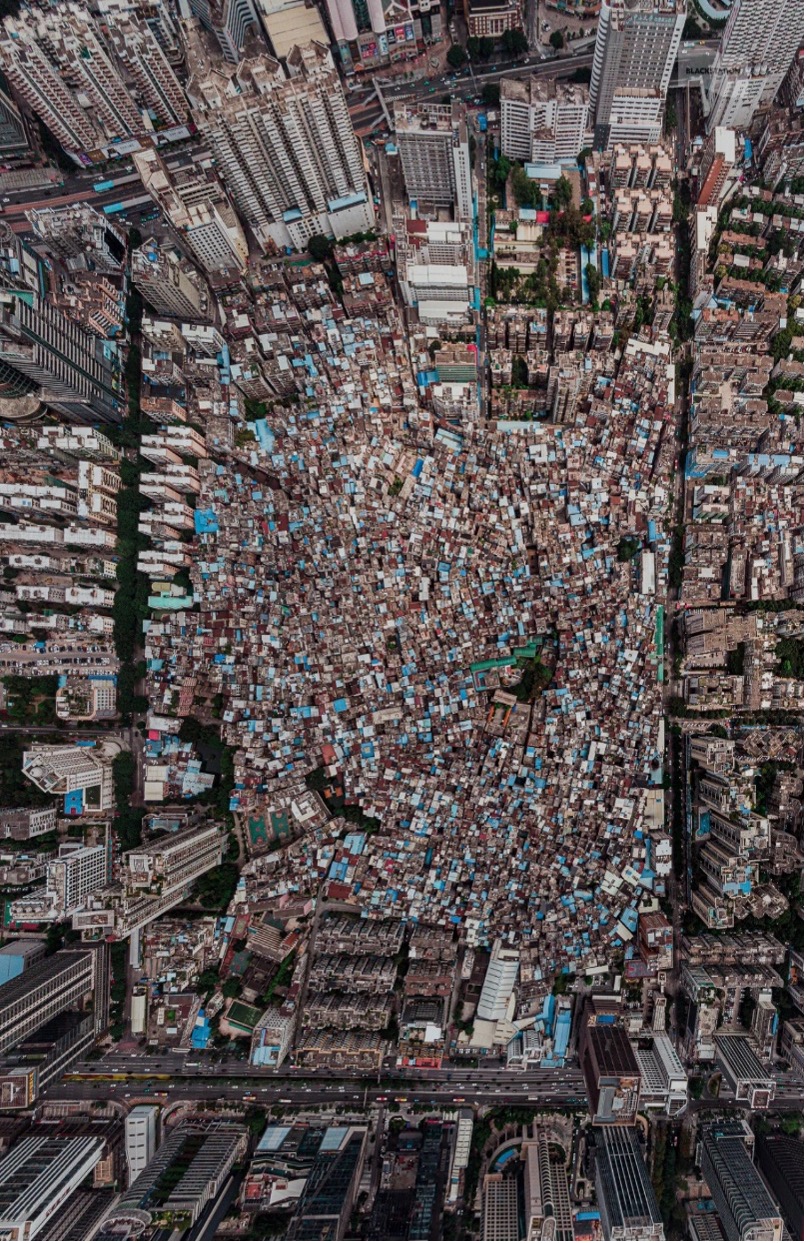
The story
The housing market has a missing curve
In Shenzhen, urban villages occupy some of the city’s most accessible land, yet their homes rent and sell for far less than nearby formal housing. Their narrow lanes and tightly packed buildings are usually described as a planning failure. For migrant workers and lower-income households, however, they are often the only way to live near jobs, transport, and daily services.
This study reads that apparent contradiction as part of the city’s housing system. It follows how former rural settlements became hyperdense urban enclaves, then revises the standard spatial model to explain why density, location, and value no longer move along one smooth gradient.
A city grows around the village
Four transitions turned rural settlements into urban infrastructure
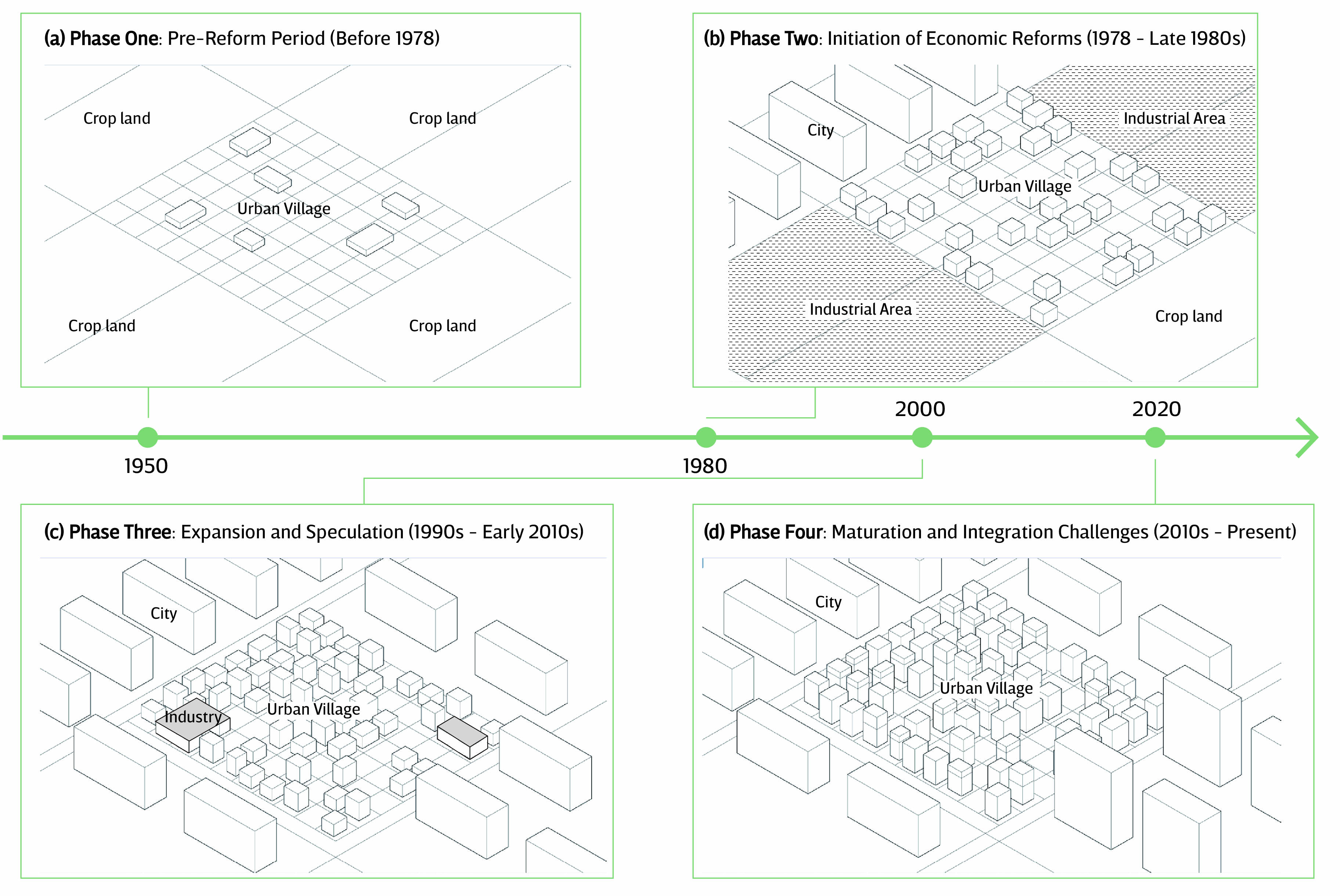
Before reform, Shenzhen’s villages were agricultural communities surrounded by cropland. Industrialization after 1978 brought factories, migrant workers, and a new demand for inexpensive rooms. Because village land remained collectively owned, residents could add floors and units incrementally while the formal city expanded around them.
By the 2010s, these settlements had matured into dense mixed-use neighborhoods. They supported housing, entrepreneurship, and social networks, but also faced overcrowding, weak infrastructure, and a growing threat of demolition. Their physical form is therefore inseparable from the institutional and economic context that produced it.
Research design
Approach
- A form-context framework linking built density to the wider spatial equilibrium of Shenzhen.
- Comparison of expected value curves before and after urban-village redevelopment.
- A three-way evaluation of value, access, and amenity.
Form–context ensemble
Spatial equilibrium model
Evidence into action
Rethinking the city model
Informality interrupts the smooth decline from center to periphery
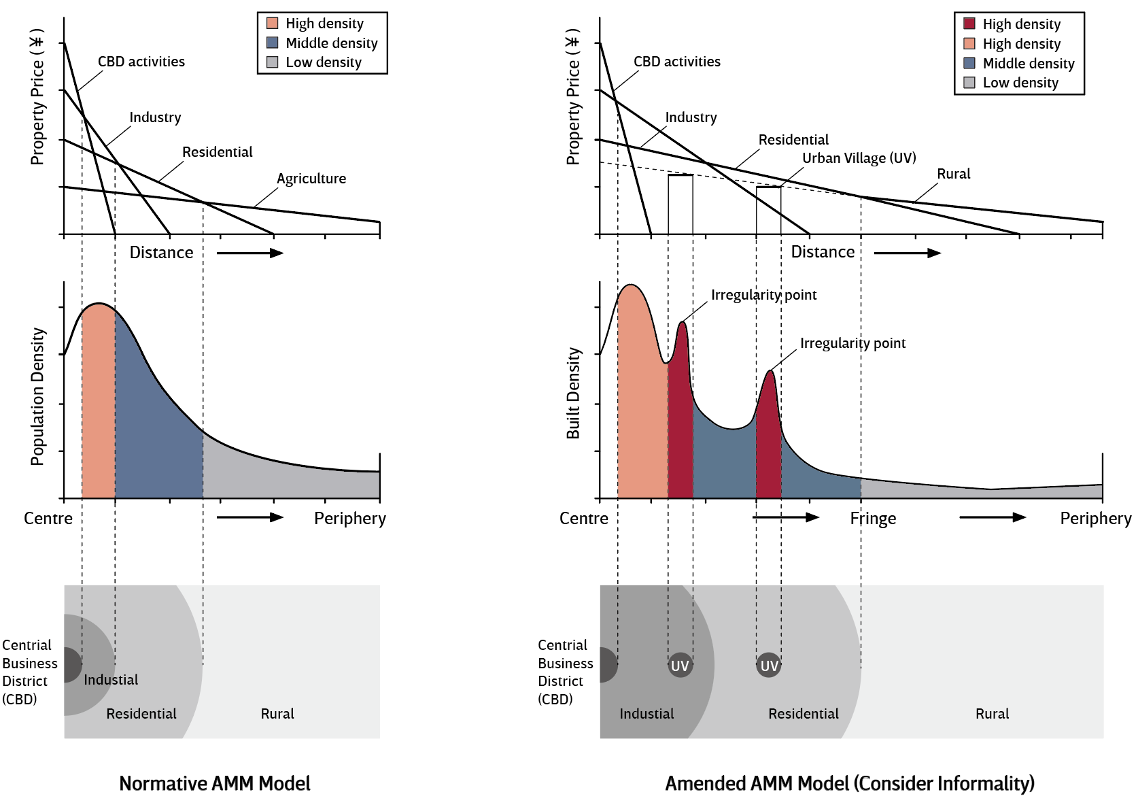
Conventional urban economics expects land value and density to fall steadily with distance from the center. Urban villages introduce irregularity points: pockets of extreme density and below-market housing embedded inside otherwise expensive districts.
The amended model treats informality as a feature of spatial equilibrium rather than an error outside it. Lower housing quality and regulatory uncertainty discount prices, while proximity to employment and services sustains intense demand. The result is an accessible, low-cost foothold that the formal market does not provide.
What the evidence says
Principal findings
- Hyperdense informal settlements sit below the expected value curve and help narrow housing-cost disparities.
- Redevelopment shifts the value curve upward while widening discrepancies between income groups.
- Selective formalization can preserve access while addressing environmental and service deficits.
Housing value through transition
A price gap becomes both shelter and redevelopment pressure
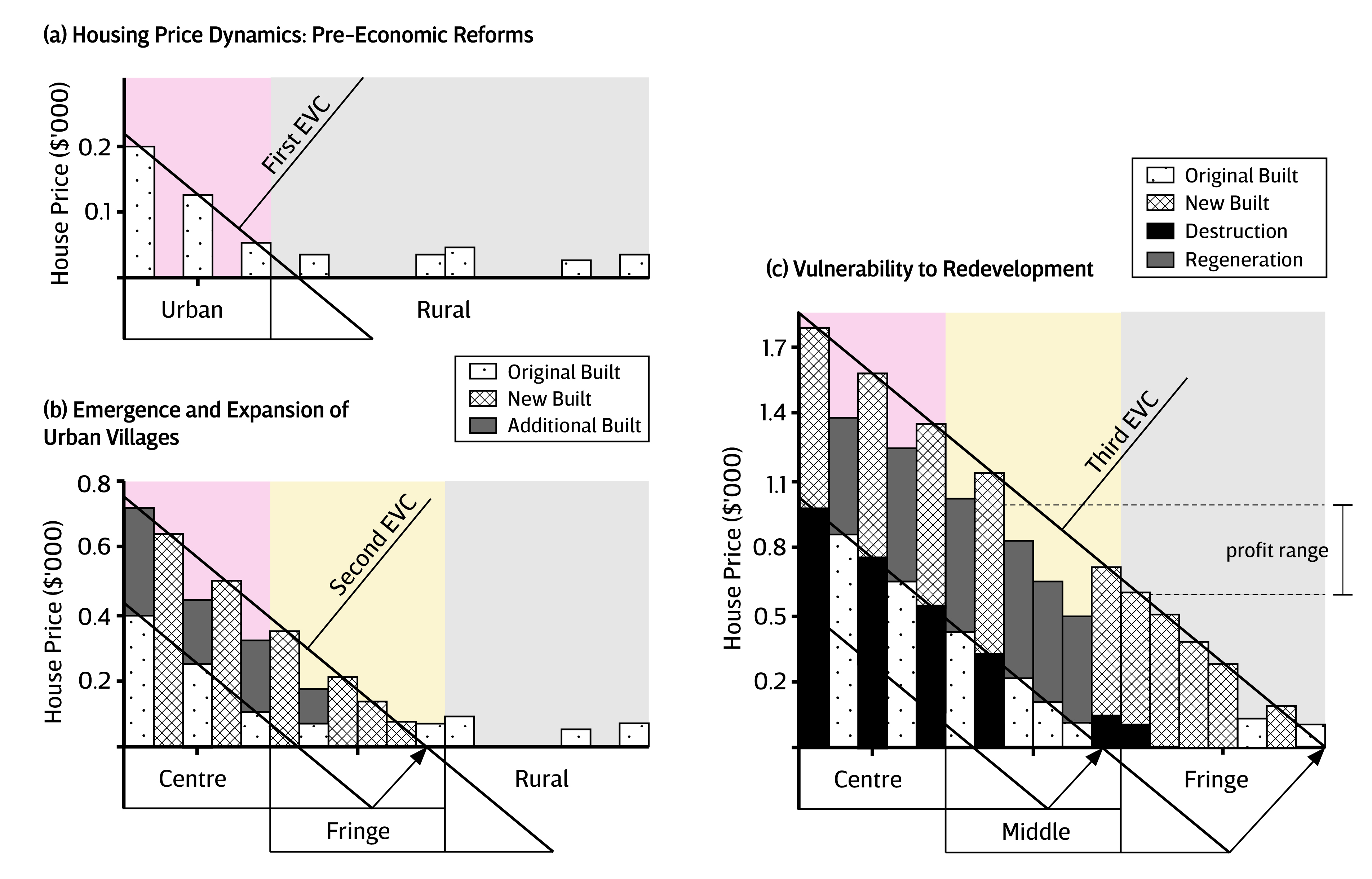
Before economic reform, housing values followed a conventional location curve and the rural-urban divide kept village land outside the formal market. As Shenzhen expanded, villagers added and intensified housing beneath a new expected-value curve, supplying rooms at prices the formal city could not match.
In the mature stage, another expected-value curve rises above the inherited settlement. The gap still supports affordability, but it also becomes a profit range: the larger the difference between existing and potential value, the stronger the pressure for demolition, regeneration, and displacement.
Value becomes vulnerability
Redevelopment is a distributive choice
The model identifies where the difference between current and potential value creates the strongest redevelopment pressure. Yet that economic signal cannot determine the policy response by itself: the same settlement may also provide irreplaceable access to employment, transport, social networks, and low-cost rooms.
Wholesale redevelopment can raise formal land value while displacing tenants and moving the expected-value curve higher across the city. The planning question is therefore not simply where demolition is profitable, but which urban functions would disappear—and who would bear that loss.
The policy lesson
Regenerate by balancing value, access, and environment
Wholesale clearance treats higher formal value as the only measure of success. The paper proposes a three-way planning test instead: the value of space, the accessibility of its location, and the environmental quality of the neighborhood must be considered together.
That framework supports a differentiated strategy. Some settlements need safety and service upgrades; others may accommodate selective formalization, long-term rental housing, or carefully negotiated redevelopment. The aim is to improve living conditions without erasing the affordability and access that make urban villages essential to the wider city.